
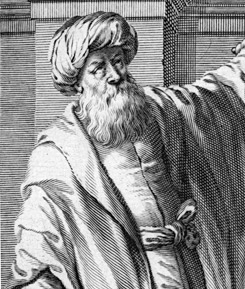
Ibn al-haytham or Alhazen (c. 965 – c. 1040), as he was known among his Western contemporaries, was an Arab mathematician, astronomer, and physicist. Born around a thousand years ago in the city of Basra in present day Iraq, Haythem’s creative powers flourished during a period known as the Islamic Golden Age.
History would indeed repeat itself where the House of Wisdom in Baghdad would succeed the Library of Alexandria as a haven for Islamic scholars and polymaths from various parts of the world. Men and women of diverse cultures contributed to the world’s classical knowledge which would be gathered and translated into the Arabic and Persian dialects. The Golden Age of Islam, dating from the 8th century to the 14th century, would witness significant advances in cultural and economic prosperity as well as in science, technology, and medicine.
al-Haytham would become the representative figurehead of this revolutionary period where he would pioneer advances in the study and understanding of human vision and perception, optics, and light. His methodology of investigation with an emphasis on experimental verification of theory would set the foundation for what would later become known as the scientific method. Known as the “Father of modern optics”, al-Haytham would compile his investigations in the Kitab al-Manzir or Book of Optics and its Latin translation De Aspectibus which would influence the works of several European scholars of the European Renaissance including Isaac Newton, Gottfried Wilhelm Leibniz, Johannes Kepler, Leonardo da Vinci, and many others.
His journey is an excellent example of scientific perseverance, dedication, and an adventurous tale for all ages.
Journey to Cairo
al-Haytham held the title of vizier in his native Basra and was well-known among the scholarly community for his aptitude in applied mathematics. His claim to be able to regulate the flooding of the Nile would be heard by the Fatimid Caliph (an Islamic steward of then Islamic state that spanned a large area of North African extending from the Red Sea to the Atlantic Ocean) al-Hakim who would invite al-Haytham to help realize a hydraulic project at Aswan, Egypt. Ancient Egyptians oriented the direction of their country along the openings of the life-giving waters of the Nile that flowed from the South. Aswan, being the southernmost town in the country, was considered the entrance to Egypt.
al-Haytham’s initial confidence in fulfilling his task at Aswan would turn to desperation once he gradually began to realize the impracticality of the project. To get a sense of al-Haytham’s realizations, one need only look to the present Aswan Low Dam, the first such construction on the Nile River, completed in 1902. Standing at 36 meters high and 2000 meters in length, the dam was made possible only with the methods and equipment available via modern technology. al-Haytham’s conception was ahead of its time, and this reality was hard to digest.

It didn’t help that his patron, al-Hakim, had a reputation as an eccentric ruler and brutal dictator who had no qualms about killing his tutors and ministers on a whim. Fearing the safety of his own life, al-Haytham would feign madness hoping the caliph would consider his failed plans to have been the reasons for his illness. Thankfully, the plan worked. al-Hakim would spare al-Haytham’s life, insisting that he be held under strict house arrest in Cairo, and there he would remain for several years until the death of the Caliph.
Within the closeted confines of the domed building that hosted his house arrest in Cairo and far from the lively discourses and debates to which he was accustomed, al-Haytham would continue his creative pursuits and forge his greatest work in the Kitab Al Manazer or the Book of Optics.
The Book of Optics
To distinguish the enormity of al-Haytham’s contributions to the study of human vision and perception and the field of optics in general, one must consider the two major theories that were prevalent in his time. The first theory, the emission theory, was supported by thinkers such as Euclid and Ptolemy who proposed that sight was realized by the eye emitting rays of light. The second theory, the intromission theory, supported by Aristotle and his followers considered sight through physical forms entering the eye from an object.
al-Haytham’s contemporaries often argued between these two theories alongside the medical traditions and studies of the eye placed by the great Roman physician Galen of Pergamon who is considered among the most accomplished of all medical researchers of antiquity. al-Haytham’s achievement was his ability to come up with a theory that successfully combined the trifecta of arguments including the emission and intromission theories, and the medical assertions of Galen.
al-Haytham would assert that “from each point of every colored body, illuminated by any light, issue light and color along every straight line that can be drawn from that point.” Legend has it that al-Haytham made his discovery one day when he saw light shining through a tiny pinhole into his darkened room. The pinhole projected an image of the outside world onto the opposite wall. This helped al-Haytham realize that he was seeing images of objects outside that were lit by the Sun.

Through repeated experimentation, al-Haytham would verify his theory that light rays travel in straight lines, and that vision is accomplished by these rays passing into our eyes. al-Haytham would further confirm his discovery by experimenting with an early prototype of the modern camera using what was called a dark room or camera obscura.
al-Haytham’s observations match perfectly with what is understood about human vision in modern anatomy and science. Our vision is composed of the images we see made up of light reflected from objects we look at. Our eyes are lenses where light enters the eye through the cornea, a window at the front of the eye. The pupils are the control mechanism that dictate the amount of light that enter the eye and are surrounded by the colored part of the eye otherwise known as the iris. Our eyes are curved lenses, and therefore bend the light creating an upside-down image in our retina which our brain turns upright helping us see the world around us.

al-Haytham’s legacy
al-Haytham would continue his intellectual pursuits throughout his house arrest, laying down his ideas about light and vision in his Book of Optics. Released from his house arrest following the death of the caliph, he would go on to make further contributions and author several books in physics, mathematics, engineering, astronomy, medicine, psychology, anatomy, visual perception, and ophthalmology.
Among his contributions were the foundations of infinitesimal calculus which Newton and Leibniz fortified centuries later, criticisms of Ptolemy’s work in celestial physics, foundational arguments on natural forces in what would later become Newton’s laws of motion, and the psychology of optical illusions etc. Most importantly, al-Haytham’s systematic means of theoretical verification through experiment would set the ground-rules for the scientific method.
Out of the 96 books he is recorded to have written only 55 are known to have survived the edicts of time. al-Haytham’s scientific spirit would be recognized long after his passing among his successors in scientists of the Middle Ages, Renaissance, and Enlightenment periods, many of whom drew inspiration from his works. While he may have stood upon the shoulders of giants, al-Haytham’s works were undeniably novel in their dedication towards objective and experimental truth and didn’t shy away from criticizing the works of his predecessors such as Ptolemy, Aristotle, and many others in his pursuit of truth.
Contrary to the popular rhetoric of Western civilization as the beacon of human thought and science, al-Haytham is representative of several other less-recognized scholars of the East whose scientific traditions and works undeniably preceded or set the foundations of the works accomplished by their Western contemporaries.

References
[1] http://www.ibnalhaytham.com/discover/who-was-ibn-al-haytham/
[2] Tbakhi, Abdelghani, and Samir S Amr. “Ibn Al-Haytham: father of modern optics.” Annals of Saudi medicine vol. 27,6 (2007): 464-7.
[3] https://www.scientificamerican.com/article/right-side-up-2008-05/
[4] Daneshfard B, Dalfardi B, Nezhad GS. Ibn al-Haytham (965-1039 AD), the original portrayal of the modern theory of vision. J Med Biogr. 2016;24(2):227-231.
[5] https://en.wikipedia.org/wiki/Ibn_al-Haytham


One thought on “Seeing through the pinhole – Ancient Scientists- Chapter 3 – Ibn al-Haytham”