
The basic actions of observation and introspection have been crucial to our growth as a species. Our ancestors gazed with great curiosity upon the star-studded night sky. Like moths to a flame, we were drawn to the expansive wonder that was the cosmos. Reminiscent of an unexplored ocean, it lay open for all to traverse and see, and yet, we didn’t see everything at once.
The act of seeing is enabled by the eye. Our eyes help us identify, interact, and obtain information about the world around us. In an elaborate cycle of signal collection, transduction, and processing our eyes convert the light from the environment into an image that is transmitted to our brain through intricate neural pathways. Nevertheless, there are fundamental limits to our sense of vision.
What we see around us may seem so self-evident as though it is just there. This makes it weird to think that what we perceive boils down to light bouncing off objects and onto our eyeballs. Light, in fact, can be characterized as a broad spectrum of waves known as the electromagnetic spectrum. In our case, much like a painter who is limited to a select palette of colors, our eyes are sensitive to a narrow portion of the spectrum known as the visible regime.
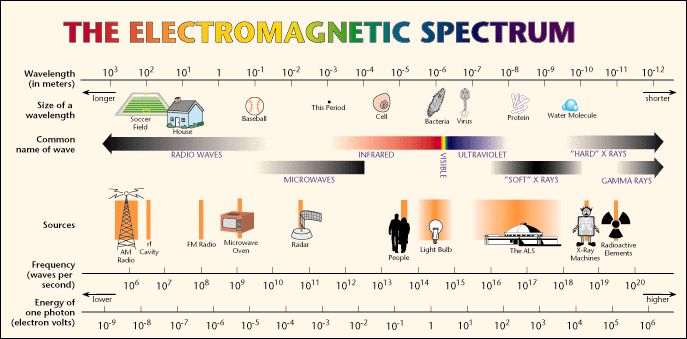
ROYGBIV, as the pneumonic goes, covers the visible range of colors from red, orange, yellow, green, blue, indigo, and violet that we can observe. Our eyes are most sensitive, by way of natural evolution and courtesy of our sun, to the yellow-green bands of the visible spectrum.
This was not known prior to the 16th century. In efforts to observe worlds beyond our own, astronomers constructed telescopes. As an extension of our eyes, telescopes helped produce an image by focusing light through an array of light sensors. The earliest telescopes were optical refracting telescopes that used an objective lens to help refract or bend light. This bending allowed for parallel light rays to converge at a single focal point that could be viewed with an eyepiece and present the viewer with a magnified image.
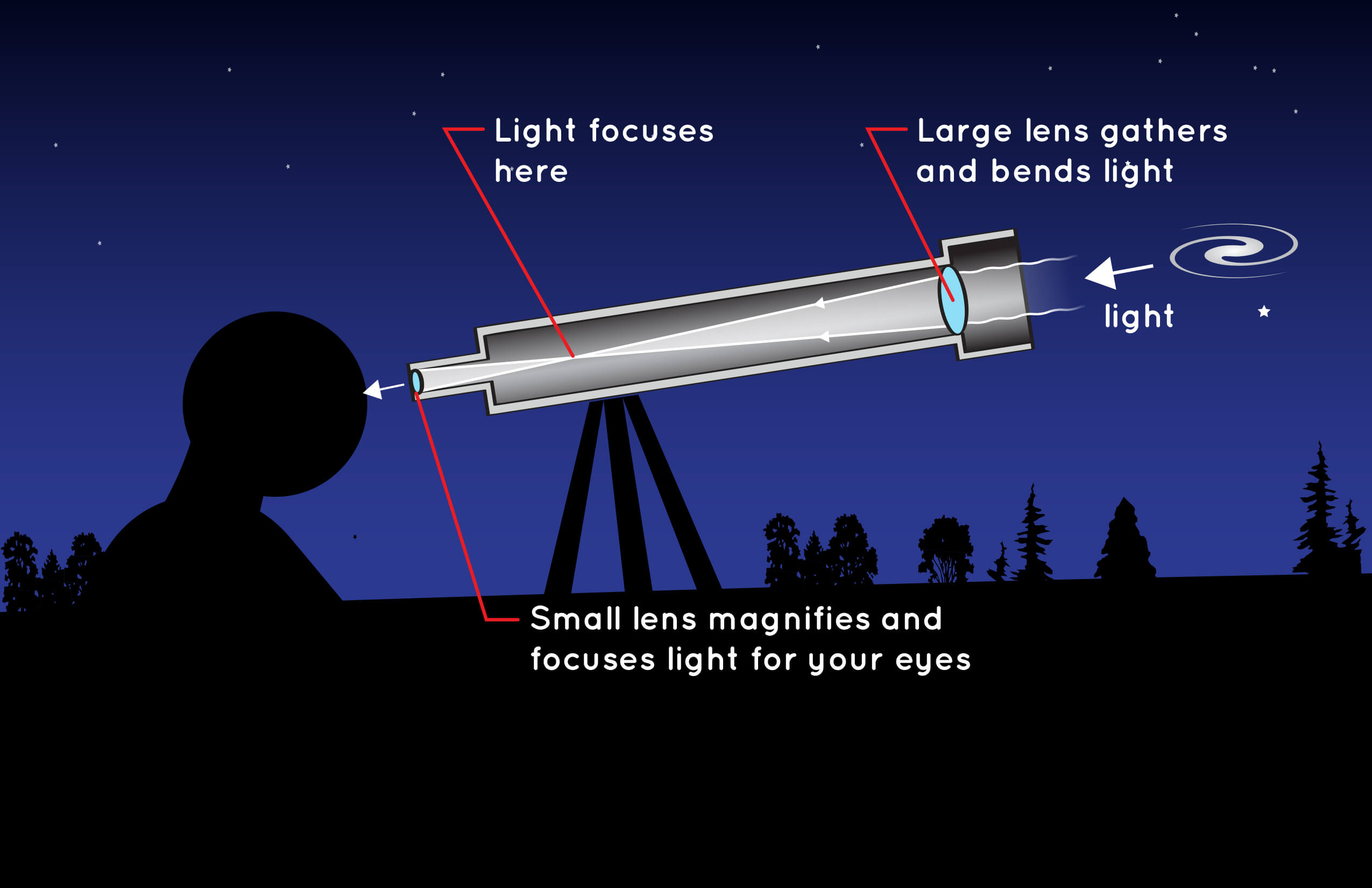
The proliferation of optical telescopes led to a flurry of research in astronomy, and for thousands of years, the information gathered about the universe was based on ordinary visible light.
It wasn’t until the twentieth century that we slowly began to explore the invisible regime of light from astronomical objects. Moving beyond the red of the visible spectrum, we alighted upon the regime of radio waves. Radio waves are best known for their use in communication technologies and pervade our modern-day lives from our phones, radios, and television etc.1 These devices receive radio waves and convert them to mechanical vibrations in the speaker to create sounds that we can interpret and discern. The exploitation of radio waves for astronomical applications came to fruition from a project seemingly unrelated to astronomy.
In the early 1930s, Karl Jansky, an engineer at the Bell Telephone Laboratories was struggling to pinpoint the cause of interference with the then-new transatlantic radio link.

In a few years, he would come to recognize that this interference or noise was loudest when the constellation of Sagittarius was high in the sky. Jansky would go on to conclude that he was detecting radio waves from an astronomical source in the direction of Sagittarius (which is in fact the center of our galaxy).
Another radio engineer, named Grote Reber would follow up on Jansky’s unique observations and in 1936 build the first radio telescope, a radio-wave detector dedicated to astronomy. His primary design was inspired by the reflecting telescope, originally invented in the seventeenth century by Isaac Newton as an alternative to the refracting telescope which suffered from chromatic aberration, the failure of a lens to focus all the colors of light onto a single focal point. Newton’s reflectors used a primary paraboloid curved mirror to reflect light onto the focal point which contained a secondary mirror that was used to direct the light onto an eyepiece.2
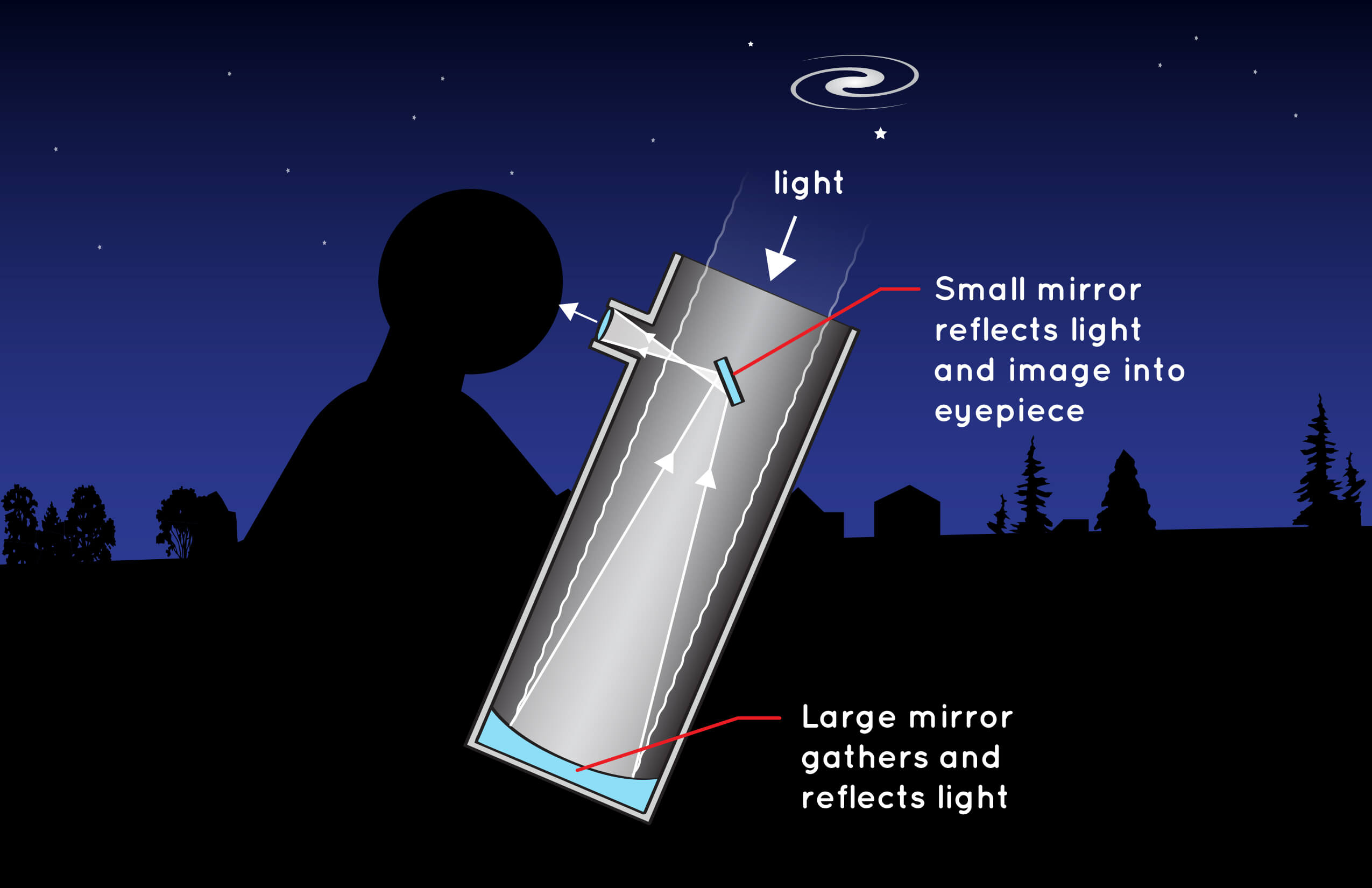
Reber’s radio telescope would have the same, in a parabolic metal dish (a reflecting antenna) measuring 31 ft (10 m) in diameter with a radio receiver at its focal point. Reber would go on to find radio waves coming from the entire Milky Way galaxy, with the greatest emission from the center of the galaxy. His observations, alongside the development of improved radio technology during World War II, would encourage the growth of radio astronomy as a unique means to map the universe.

Modern radio telescopes are not that different from Reber’s prototype and are exquisitely sensitive. Limitations in resolution have been accommodated by connecting radio telescopes with others on the other side of the Earth to provide for a baseline that is the span of the Earth’s diameter – this is the equivalent of having a telescope as large as the planet itself. The Very Large Array (VLA) system in Socorro, New Mexico is a small-scale analogy of the same where 27 telescopes are arranged along the arms of a gigantic Y that covers an area 27 km in diameter. In such a phased array, the individual telescopes are connected as though they were a single size of the remotest elements and provide radio views of the sky with resolutions comparable to the very best optical telescopes.3

Over the course of their rich history, radio telescopes have provided some of the greatest insights into the past and future of our universe. By peering into the depths of space, to the distant stars and galaxies, we are also looking back into time. If we are to see an object twelve billion light years away, we are seeing it as it was twelve billion years ago in time. The further we look out into space, the further back in time do we probe, all the way toward the horizon of the universe, to the epoch of the Big Bang.
The light from back then pervades the entire universe in a cosmic background radiation that has traversed the fabric of space and time over billions of years. This light has been flung out so far that its signal is faint and shifted far beyond the visible spectrum of light. It was by coincidence that radio astronomers Arno Penzias and Robert Woodrow Wilson stumbled upon these faint melodies, otherwise seen as a constant background noise observed in their radio antenna at Bell Labs while setting point for routine radio communications.
As the galaxies and stars continue to recede from us in a supposed expansion of the universe, the light that we observe of these celestial objects becomes shifted toward longer and longer wavelengths in the red and into the radio. Radio telescopes can detect these faint signals listening as they do to what are melodies from a long- forgotten past of the cosmos.
1 Scottish physicist James Clerk Maxwell, who developed a unified theory of electromagnetism in the 1870s predicted the existence of radio waves. In 1886, Heinrich Hertz, a German physicist would be the first to apply Maxwell’s theories to transmit and receive radio waves.
2 The Newtonian reflector had its own share of limitations in sharpness and contrast. Multiple designs of the reflecting telescope have been constructed over the course of history to address these issues with reflecting telescopes becoming ubiquitous on space telescopes and spacecraft imaging devices.
3 Basically, combine the signals from all 27 telescopes to make a composite image of the same object with greater focus and resolution.
References
[1] Land, M.F.; Fernald, R.D. (1992). “The evolution of eyes”. Annual Review of Neuroscience. 15: 1–9.
[2] Stephen G. Lipson, Ariel Lipson, Henry Lipson, Optical Physics 4th Edition, Cambridge University Press.
[3] Sagan, Carl. Cosmos. 1st Ballantine Books ed. New York: Ballantine Books, 1980
[4] Freedman, Roger A, and William J Kaufmann. Universe. 8th ed. New York, NY: W.H. Freeman and Co., 2008.
[5] Carroll, Bradley W, and Dale A Ostlie. An Introduction to Modern Astrophysics. 2nd ed. San Francisco: Pearson Addison-Wesley, 2007.
[6] Visible Light and the Eye’s Response
[7] Radio Waves


One thought on “Radio Telescopes: Listening to the Past”