
The night sky is privy to many stories. It has been a silent observer to the history and evolution of life on our planet. Wrapped within its fabric are the stars, distant and static candles that guided our ancestors in the early days of humanity. Among them, there were a few rebellious elements whose behavior elicited curiosity. Unlike their brethren, these “stars” wandered across the night sky. It was in reflection of these planets that our ancestors formed their beliefs, traditions, and their livelihood.
The advent of science and technology threw into sharp relief the insignificance of our existence within the greater expanse of the cosmos. Where there was once a measure of certainty coveted by religious doctrine, there was now a great enlightenment where humanity sought to understand its place in the cosmos. We would soon realize that the planets were not wandering stars. Rather, they were worlds beyond our own; a fact that shattered the ancient and then undisputed geocentric idea that the Earth is the center of the universe and is thus unique.
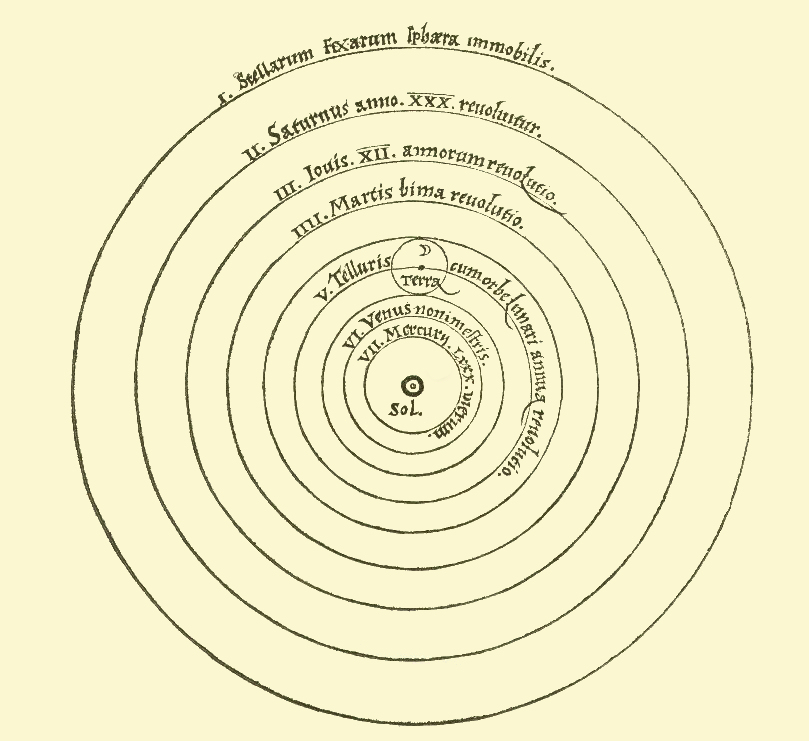
The Copernican model of heliocentrism, proposing the Sun to assume a central point with the Earth and other bodies revolving around it, was the nail in the coffin for the geocentric argument. Giordano Bruno, an Italian philosopher, would go even further to suggest that the fixed stars were akin to the Sun and were possibly accompanied by their entourage of planets, lending to a cosmic pluralism of an infinite number of inhabited worlds.
In the wake of the destruction of the old order, a new wave of curiosity would sweep the scientific community motivating greater study of the night sky’s mysteries and the worlds that lay beyond our own.
exoplanets
The first systematic search for exoplanets (exo is Greek for outside; planets far outside our solar system) began in the late nineteenth century. A breakthrough only occurred a century later in 1992 when the floundering belief in the uniqueness of our place in the cosmos was irrevocably laid to rest by the detection of two planets orbiting a pulsar (a rotating star that emits radio waves like a lighthouse, and can be detected from Earth if its beams cross our direction).
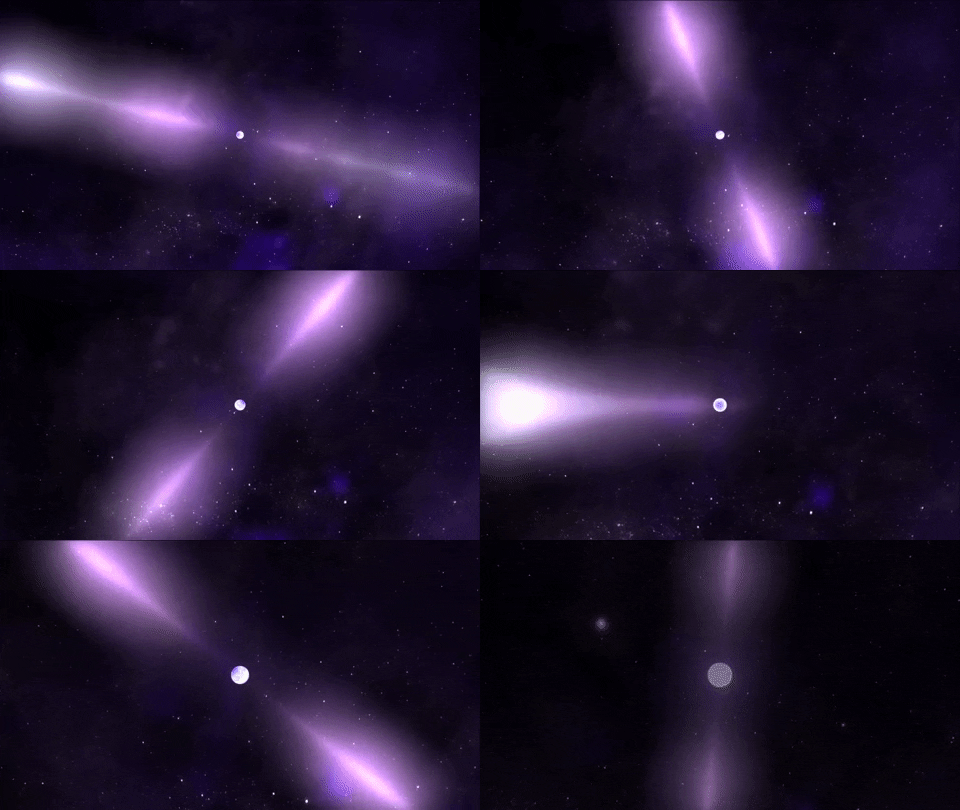
As monumental as this discovery was, the focus of the scientific community would immediately shift toward the discovery of exoplanets orbiting a sunlike star as opposed to the remnant of a supernova. This would be motivated by another question that humanity has fervently sought an answer to: Are we alone in the universe? Finding an Earth-like planet, especially one teeming with life, has been and remains the driving impetus for exoplanet exploration.
We wouldn’t have to wait too long as the first exoplanet, one as massive as Jupiter, orbiting a sunlike star (51 Pegasi) 50 lightyears (1 lightyear = 9.46 x 10¹² km; in other words, really far away) from Earth would be discovered in 1995. Ever since, we have discovered countless other worlds (the current confirmed count is at 5005) beyond the local neighborhood of our solar system. Most of these exoplanets cover a “small region” within thousands of lightyears of our solar system of the Milky Way Galaxy. This is as far as we can probe with our current telescopes, although NASA’s Kepler Space Telescope has indicated that there are far more planets than stars in our galaxy.
The closest known exoplanet to Earth is Proxima B in the Proxima Centauri system (Check out a 3D model of it here!). That is still 4 lightyears away! Yet, despite these enormous distances, astronomers have discovered creative means to spot these distant worlds.
how to find an exoplanet?
Astronomers have developed several techniques to search and identify planets far beyond our solar system. Five methods most commonly used to discover exoplanets include radial velocity, transit photometry, direct imaging, gravitational microlensing, and astrometry. Let’s dig a little deeper and see how these techniques help us find exoplanets.
1. Transit method
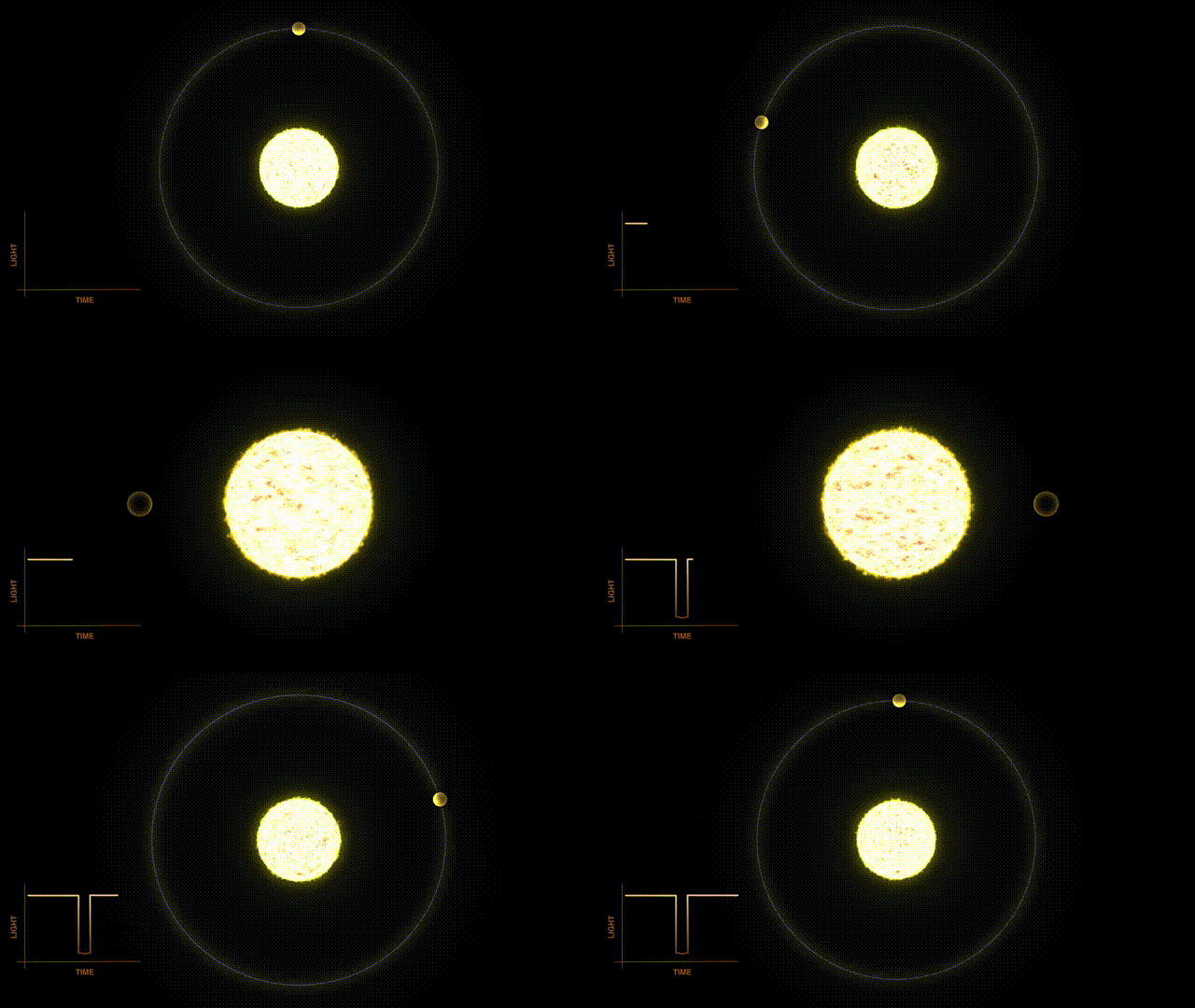
The transit method describes the transition of a planet passing directly between our line of sight and the star it orbits. When this happens, the planet blocks some of that star’s light and for a very brief period, the star’s light becomes weaker and dimmer. This tiny change, when detected by our highly sensitive telescopes, is enough to suggest the presence of an exoplanet around a distant star. This method is great for finding exoplanets in close orbits and measuring their diameters. It works best with space telescopes as opposed to grounded telescopes. Unfortunately, the transit method fails to determine whether the blocking planet is actually a small star, and cannot be used to find exoplanets that do not cross stars.
2. Radial velocity
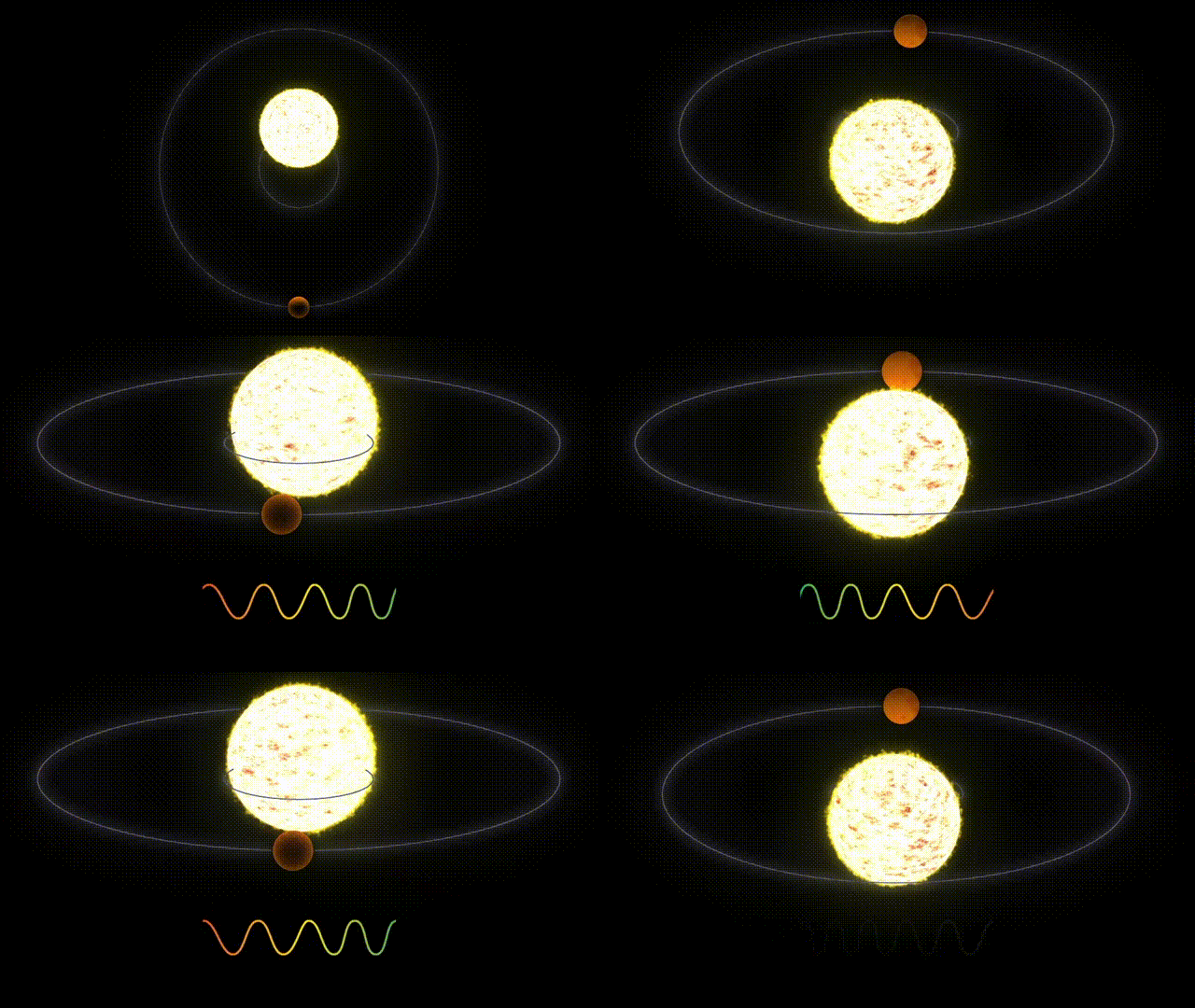
Just as much as a planet is pulled into orbit by a star’s gravitational influence, the orbiting planet also provides a gravitational tug on its star. In other words, orbiting planets cause their stars to wobble. This wobble affects the star’s light, causing it to change color. If the star were to wobble and move in the direction of the observer it appears bluer. If the star moves away from the observer, it appears redder. This is due to the Doppler effect, the same reason behind why an ambulance siren changes pitch as it passes you. Observing these changes is known as the radial velocity method. The radial velocity method is great for finding planets in close orbits and works well with ground-based telescopes. It is not favorable for discovering small exoplanets or those in distant orbits, and measuring exoplanet diameters.
3. Gravitational microlensing

This technique takes advantage of the gravitational interplay between a star and its planet. Light from a distant star gets bent and focused by gravity (much like light passing through a microscope and onto a paper) making the star’s light temporarily brighter as a planet passes between the star and the Earth, allowing us to infer the presence of the orbiting planet.
4. Astrometry

Unlike the radial velocity method where we observe a star’s wobble as a means to infer a planet’s presence, astrometry involves detecting the star’s position as it wobbles around in space. This is not easy as stars wobble very minute distances, something that is very difficult to measure all the way from our home planet. To track the wobbling motion of the star, astronomers capture a series of images of the star and its neighboring stars in the sky. Taking each picture in hand, astronomers then compare the distances between the reference stars and the target star. If the target star has moved relative to the others, astronomers can then check for signs of exoplanets. Ground-based telescopes aren’t the best for this method as our atmosphere bends and distorts light, and astrometry requires a significant amount of precision in its optical measurements.
5. Direct imaging
Credit: https://exoplanets.nasa.gov/
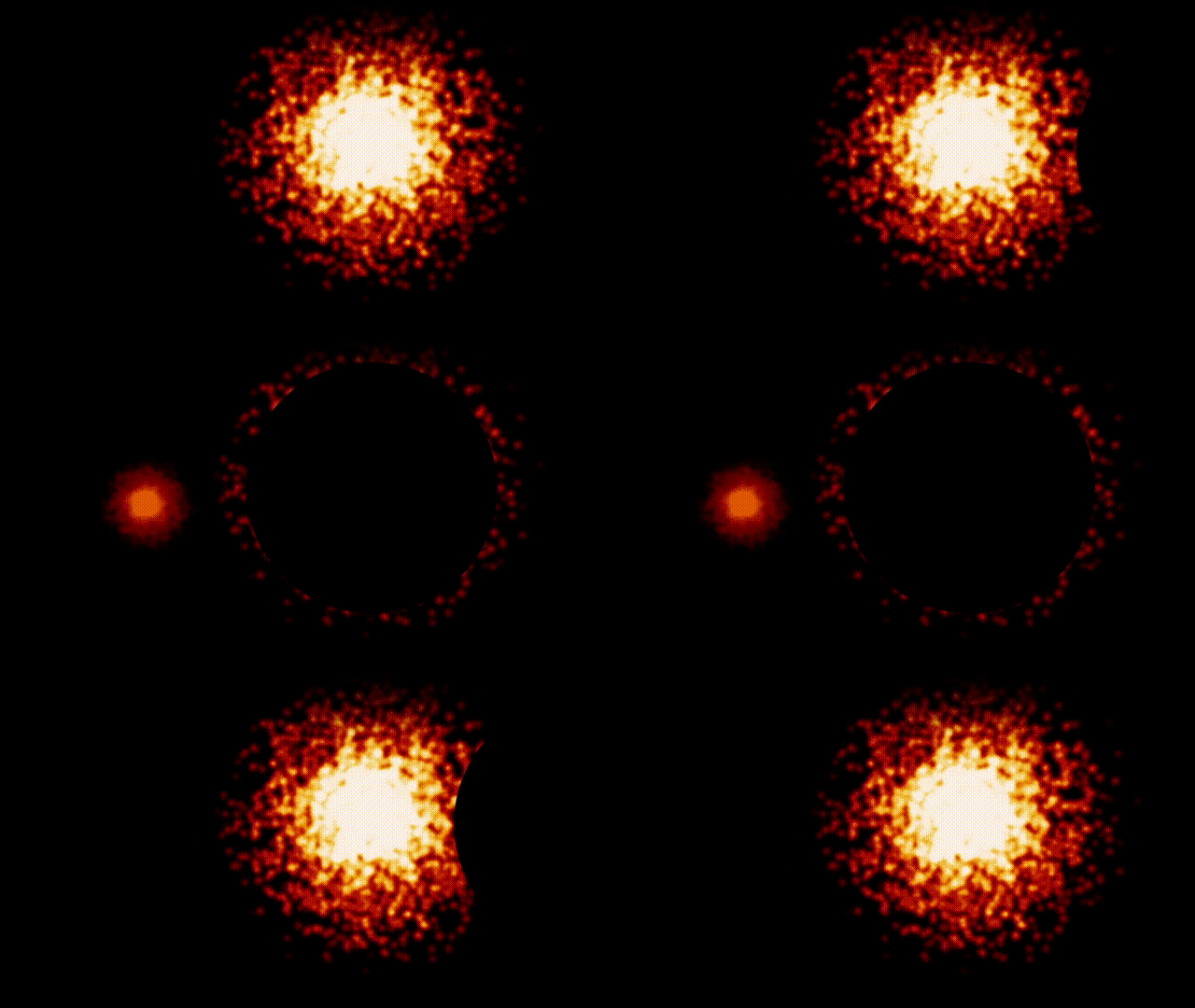
Sometimes the best way to find an exoplanet is to just look for it. We can spy faint objects next to stars by tracking their motion over a long period. Direct imaging often involves removing the glare of the stars that exoplanets orbit allowing astronomers to capture live pictures of the exoplanets that orbit them. This technique doesn’t work for exoplanets close to extremely bright stars or ones that are too far away, but it is excellent for exoplanets with large orbits and ones that do not cross their stars.
worlds beyond our own
Our galaxy alone contains 100 billion stars, including the Sun. If each of these stars hosts a solar system of their own, the number of planets far overwhelms the number of stars in our galaxy, ranging in the trillions. There is a diverse menu of exoplanets ranging from gas giants, Neptunian, super-Earths, and terrestrial and we continue to discover various new planetary bodies.

One such recent discovery concerns the Proxima Centauri system, the star closest to the Sun (approximately 4 lightyears away), and host to Proxima B (an Earth-like exoplanet) and Proxima C (either a super-Earth or mini-Neptune). A faint signal in the radial velocity data originally part of a 2020 study on Proxima B led to the finding of Proxima D, a sub-Earth exoplanet.
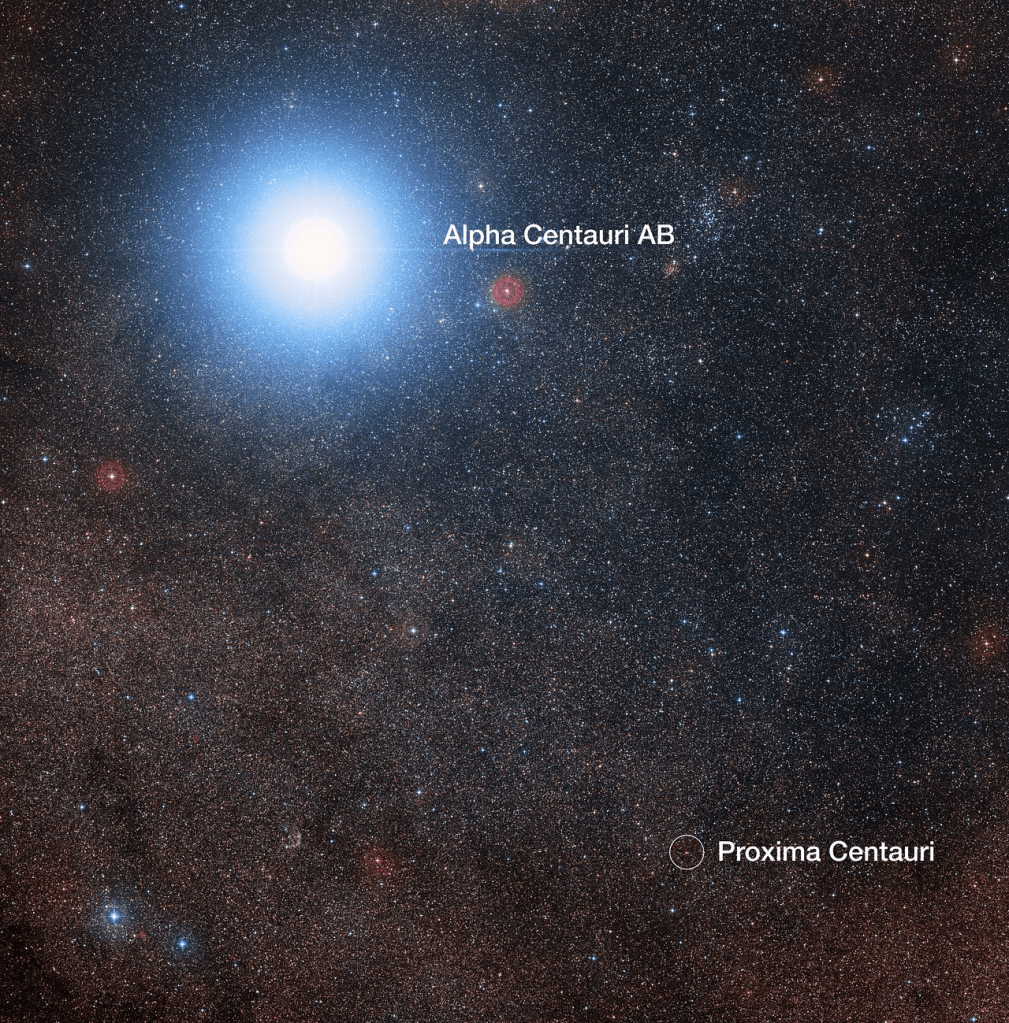
The fluctuations caused by Proxima D’s presence were so small that it caused the star to wobble just 40 centimeters per second. The discovery attests to the power of the radial velocity method and its ability to detect such subtle motions from great distances. Proxima D is also the smallest exoplanet ever detected to date. Being one-quarter the Earth’s mass, it is the least massive and innermost planet of the Proxima Centauri system. Its orbit is far too close to its star to be considered habitable.
This discovery further diversifies the categories of exoplanets to look out for, now with the addition of “light” planets much like our Earth, which are expected to be the most abundant in the galaxy and with the greatest potential to host life as we know it. Unfortunately, the bulk of these planets are hundreds or thousands of light-years away, so we have no way to reach them anytime soon. Nevertheless, we can remain optimistic in our current observational efforts to measure their masses and temperatures, gauge their atmospheres, and detect signs of life in the light we receive from these distant worlds.
Much like our ancestors, but just a little wiser, we continue to follow the rhythms and motions of the wide expanse of the cosmos in our curiosity to explore the many worlds that exist beyond our own.
More information
Feature Image Credit: ESA/Hubble, M. Kornmesser


