
Look to the night sky and amid the vastness of space, you will find candles that have burned bright for eons. In their light, we find stories that take us back to a time when the universe was younger and darker.
But, father time catches up to all of us. As they near the end of their journey, the candles waver, their light fading as they disappear into the darkness of space save for a select few who await a different fate. This rebellious few do not fade away but rather meet their end in a colorful mosaic that sets the stage for new beginnings.
The candles that I speak of here are the stars, luminous spheres of plasma that illuminate our night sky. The mosaic refers to the powerful and luminous stellar explosions, transient astronomical events, that occur during the last evolutionary stages of a massive star, commonly referred to as supernova.
Now, here at The Procrastinating Scientist, we always like to consider the bigger picture. So today, we explore an extreme case of a supernova, a hypernova. We begin by asking,
How do stars live?
Not all stars share the same fate. The lifespan of a star depends on its mass. The more massive the star, the faster it fades away. The Sun, for example, is about 4.6 billion years old, and will last another 4.5 – 5.5 billion years. Stars that are 10 times the mass of the Sun burn only for 100 million years while stars one-tenth the mass of the Sun burn 100 billion years or longer.
Those are some large numbers being thrown around casually. For context, our ancestors have been around for about six million years but the modern form of humans or homo sapiens evolved only about 200,000 years ago. Human civilization is a recent enterprise of 6000 years with industrialization beginning only in the 1800s and the average lifespan of a human is around 80 years. Simply put, our existence is fleeting compared to that of stars.
Stellar evolution is the process by which a star changes over the course of time. All stars are born from nebulae, clouds of gas and dust, and over the course of millions of years, these proto- or infant stars settle down and transform into what is known as a main-sequence star. The Sun is a typical main-sequence star.
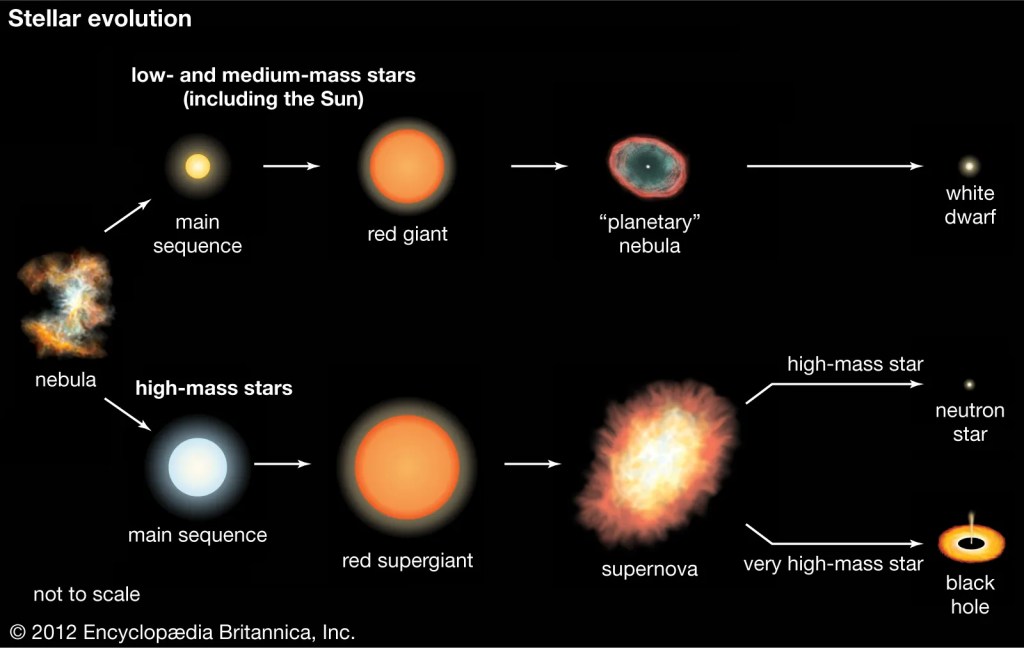
The death of a star is directly related to how fast it burns up its energy reserves. Nuclear fusion is the process that powers a star for most of its life. Initially, the energy generated by a main-sequence star, like the Sun, is through the fusion of hydrogen atoms at its core. Hydrogen atoms combine to produce Helium resulting in an abundance of the latter and the depletion of the former fuel.
Eventually, the star begins to fuse the Hydrogen fuel along a spherical shell surrounding a mostly Helium core. This process causes the star to grow in size, and evolve into a red giant. Stars with half the mass of the Sun can also generate Helium fusion at their core while more massive stars fuse heavier elements in a series of concentric shells.

All out of fuel
Once this nuclear fuel has been exhausted, a star like the Sun collapses into a dense, small body known as a white dwarf, expelling its outer layers into a planetary nebula.
The word “planetary nebula” is a misnomer. It does not mean clouds of gas and dust consisting of planets. The word originated in the 1780s when astronomer William Herschel viewed these objects through his telescope and named them so because they resembled the rounded shapes of planets.
These are celestial bodies of which as yet we have no clear idea and which are perhaps of a type quite different from those that we are familiar with in the heavens. I have already found four that have a visible diameter of between 15 and 30 seconds. These bodies appear to have a disk that is rather like a planet, that is to say, of equal brightness all over, round or somewhat oval, and about as well defined in outline as the disk of the planets, of a light strong enough to be visible with an ordinary telescope of only one foot, yet they have only the appearance of a star of about ninth magnitude.
-William Herschel,
Quoted in Hoskin, Michael (2014). “William Herschel and the Planetary Nebulae”. Journal for the History of Astronomy. 45 (2): 209–225
Stars more massive than the Sun can explode in a supernova releasing much of their material in a shockwave that expands into the vacuum of space. By releasing the bulk of the chemical elements they had originally sustained in their core (Hydrogen, Helium, Carbon, Neon, Oxygen, Magnesium, Silicon, and Iron), stars enrich the interstellar medium. The resulting shock-wave produced from a supernova also helps trigger the formation of new stars. The cores of such massive stars then collapse into an extremely dense neutron star, and in certain cases, a black hole.
Then, what are hypernovas?
Hypernovas are supernovas but on a grander scale. The energy released within mere seconds of this explosion is greater than the energy that the Sun will release in its entire lifetime.
The Sun radiates ~ 3.83 x 1026 W of energy. The standard light bulb for a table lamp has a wattage of 60 W. Thus, the sun radiates energy equivalent on the order of ~ 1024 light bulbs (10 followed by 24 zeroes). Supernovas shine with the brightness of 10 billion suns (1034 light bulbs) which is the total energy output of the sun in its 10 billion year lifetime. Hypernovas release energy in excess of this amount. So, a lot of light bulbs!
As to how exactly all of this happens, astronomers aren’t exactly sure but various models have been proposed.
The collapsar model describes hypernovas to occur when a star 40 times more massive than the Sun collapses into a black hole. If this star was rapidly spinning, the material around the black hole is swept into an electromagnetic frenzy and creating jets of material that blast away from the black hole at nearly the speed of light. When these jets slam into any remaining ejecta from the initial supernova explosion, prior to collapse, a fiery burst of energy is reignited forming a hypernova explosion.

Another potential model considers hypernovas to originate, not from a single star, but from a binary system. In a demonstration of stellar fratricide, there may be a binary system of stars where one of the stars explodes, leaving behind a neutron star. Its stellar sibling would then follow suit, and detonate as well but if the conditions are just perfect, the exploding sibling can dump enough material onto its neutron star neighbor to trigger a runaway nuclear reaction. This runaway nuclear reaction can lead to another supernova, but much bigger, aka a hypernova.
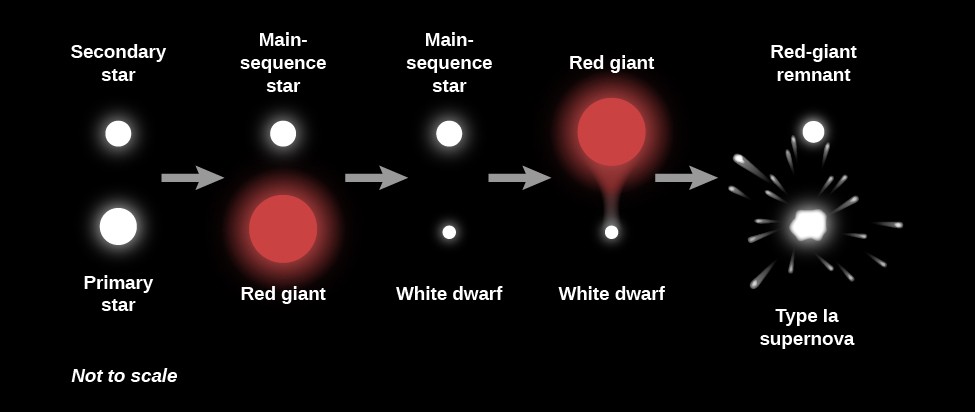
Uncertainty persists on which model matches up with reality but astronomers agree on one thing, you don’t want to be nearby when a hypernova is going off. The light released from a hypernova is several million times greater than all of the light of the stars in the Milky Way galaxy put together. The energy released in a hypernova is also enough to destroy the Sun 100,000 times over or power humanity for several billion years.
Unfortunately, despite all their awesomeness, hypernovas are a rarity with only a dozen examples observed in cosmological surveys over the last few decades. Still, they are yet another example of the amazing phenomena that the universe has to offer, at least when it comes to really big explosions.


