
With the 2021 United Nations Climate Change Conference (COP26) underway, I thought a refresher on climate change would be useful.
This will be a four-part series, inspired by a post I had written several years back in The Pensive Reverie, my personal blog. The science behind climate change hasn’t changed too much (though my writing has, and for the better) and the risks remain very real to this day.
Let us start with the basics.
Weather vs. Climate
Weather and climate are not equivalent. The difference between the two is a measure of time.
Weather is local and short-term. It refers to atmospheric conditions over a short period of time. Climate is long-term and refers to atmospheric behavior over relatively long periods of time. Climate also isn’t diluted to one single location, and defines the average weather conditions in a given area over a long period of time.
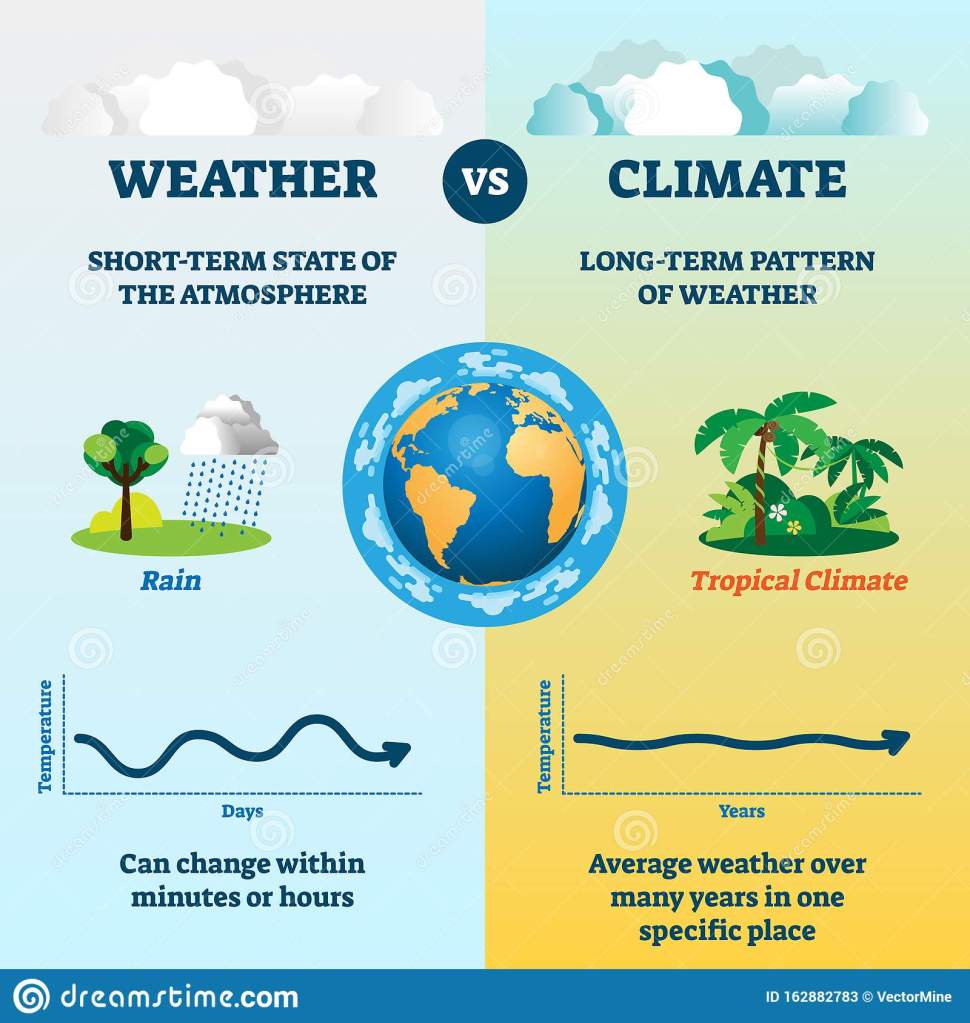
How long? Well, usually around the order of tens of thousands of years. So when we come across a few winters that aren’t as cold as usual, its technically incorrect to point it out as climate change. These are just anomalies that do not represent any long-term change.
On the other hand, it is not in our best interests to underestimate gradual changes in climate over long periods of time. This is because small changes in climate can equate, in the long run, to major effects on global ecosystems. For example, the Ice Age seems to describe a world drastically different compared to present day. In reality, average global temperatures during the Ice Age were only 50C cooler than average modern day temperatures.
Ok, then what is all this talk about global warming?
Things Are Heating Up
Climate change and global warming are two terms often used interchangeably to describe climate transitions, but much like weather and climate, there is a subtle distinction.
In the early 20th century, scientists used the term climate change when writing and discussing events such as the Ice Age. Once scientists began to recognize the specific risks posed by human-produced greenhouse gases on the Earth’s climate and atmospheric conditions, they needed a word to describe it.
Enter Wallace Broecker, an American Geochemist and a Newberry Professor in the Department of Earth and Environmental Sciences at Columbia University, who in his 1975 journal publication for Science, Climate change: Are we on the brink of a pronounced global warming?, introduced the word global warming into the public lexicon.
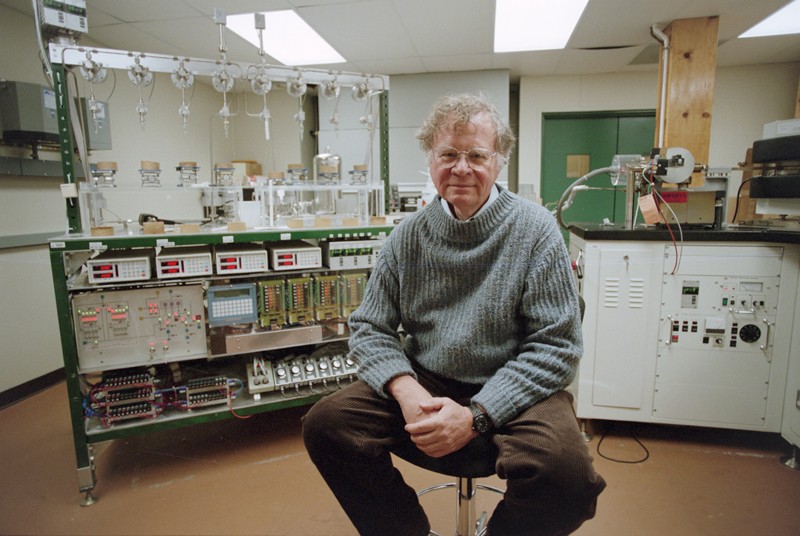
Post-Broecker’s publication, the term global warming gained currency and was used to describe all modes of large-scale impact on our planet including issues such as the Antarctic ozone hole.
Broecker’s terminology didn’t gain much traction within the scientific community. The scientific consensus is that the planet as a whole is warming. Things are heating up, but scientists prefer to use the term global change or global climate change to describe this ramp up in average global temperatures. One may consider this a matter of semantics but it isn’t.
Global warming can be interpreted as a uniform effect (warming everywhere on Earth) when in truth a few regions in the world may cool slightly even if our planet were to warm up. It is not an actual global warming in that sense. There is also a social aspect to all of this. Climate change sounds less frightening to the ear than global warming although the latter term is more popular in the public eye. A few scientists and activists also prefer to use global warming to imply human involvement in describing current climate transitions. In the end, it is up to one’s discretion to decide which phrase fits best.
With these concepts set in place,
Is Earth really warming up?
The short answer: YES!
After laboriously working through a century’s worth of temperature records, various independent teams of scientists have converged on a rise of 10C in the average surface air temperature of Earth since 1900. Over half of this increase has occurred since the mid-1970s.

From 1900 to 1980 a new temperature record has been set on average every 13.5 years. This has dramatically shifted in the period from 1981-2019 where a new record was set every 3 years. 2020 was considered the second warmest year on record, with the 10 warmest years having occurred since 2005.
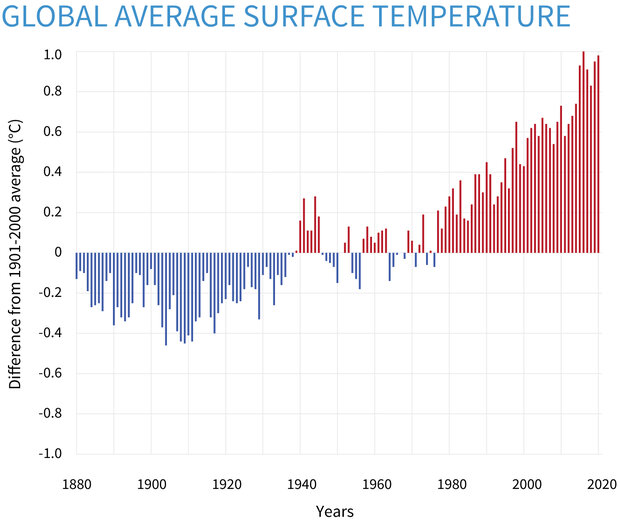
While this degree of warming may not sound like a big deal, it does make a big difference when one works from the ground up. The biosphere is a sensitive entity where even minute, but global, changes may tip the scales unevenly for the living organisms, like ourselves and many other species on our planet, that depend on it for survival.
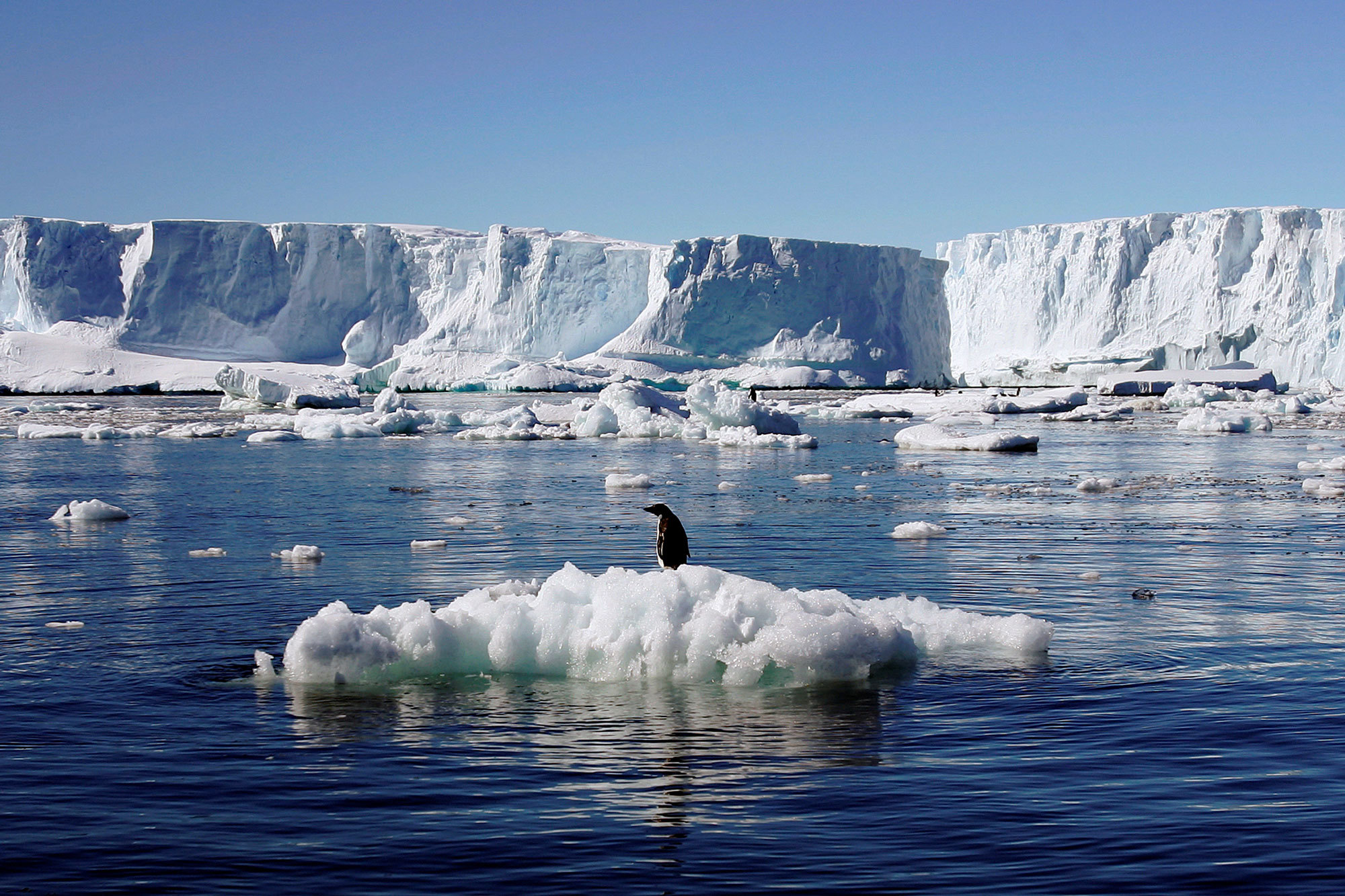
Any warming can serve as a base from which heat waves can become worse. The effects are particularly pronounced in certain locations like the Arctic which has experienced an overall warming. Apart from the numbers, there’s a wealth of environmental evidence to bolster the case in favor of the Earth warming up. Pictures speak a thousand words, so here are a few:
The melting ice
A lengthening of the growing season around much of the Northern Hemisphere

The migration of various forms of life

Other observations from the Intergovernmental Panel on Climate Change (IPCC) highlight the warming trend of the last 50 years being nearly the double of the last 100 years. This is accompanied by a vast increase in ocean temperature to greater depths (the oceans absorb 80% of the heat of Earth’s climate system), increasing droughts, increased precipitation in eastern regions of the Americas, and northern regions of Europe and Asia, drying trends in Africa, and the Mediterranean, etc.
An Age-Old Argument
Climate change is a global issue that brings science and politics together while simultaneously transcending the social responsibilities held by both institutions. It is a polarizing subject and among one of the most daunting challenges for humanity’s future. Why is that so, you may ask? Well, the solution to climate change is only partly about the science.
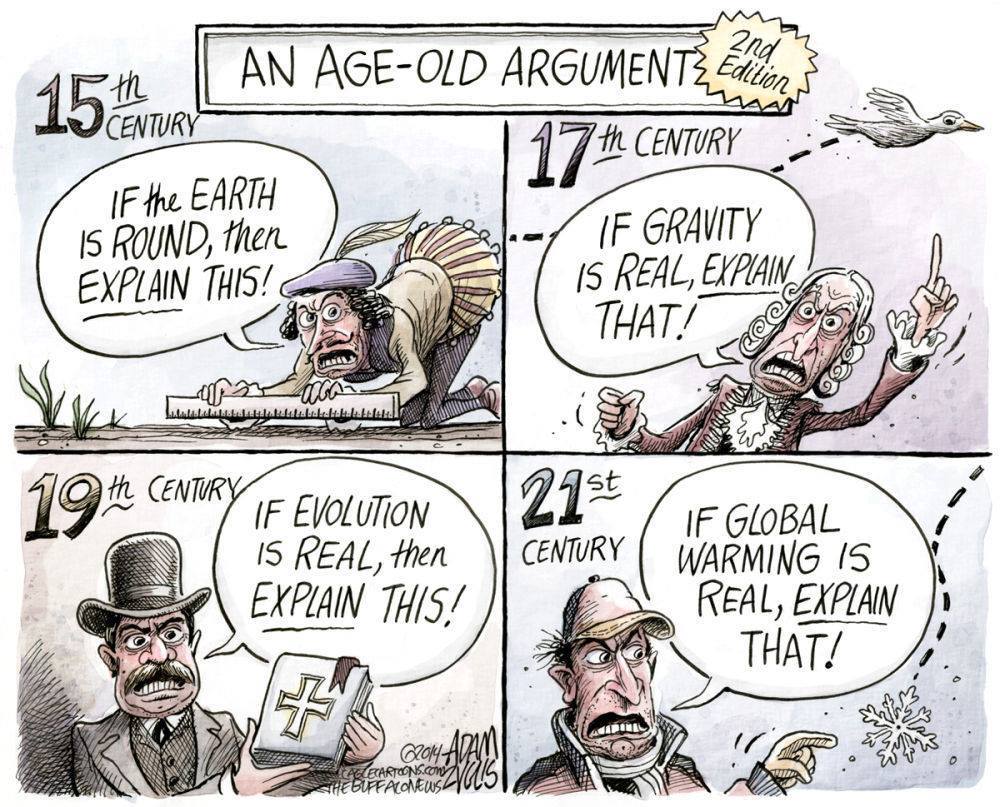
There remains a divide between the general public, the government, and the scientific community when it comes to tackling climate change. It mostly boils down to communicating the science and taking initiative based on the scientific evidence that is out there.
Today, we have tackled the basics of the problem. Next up, lets look a little bit deeper into the science behind climate change and how we got here.


One thought on “Climate Change – Part 1 – The Basics”