
The universe has a penchant for cooking up all sorts of weird things. If it weren’t enough with black holes, supermassive stars, etc. astrophysics also postulates the existence of nuclear pasta, an exotic type of matter, within the interiors of neutron stars.
To understand neutron stars, we need to know how stars behave. The bigger they are, the faster they burn. Stars burn by fusing hydrogen atoms into helium in their cores. What happens to a star once all its hydrogen fuel is spent depends on the star’s mass. For stars like our Sun, once the hydrogen is gone, gravity will cause its core to contract and heat up. The outer layers of our Sun would then expand causing it to become a red giant that will engulf everything up to our planet’s current orbit.
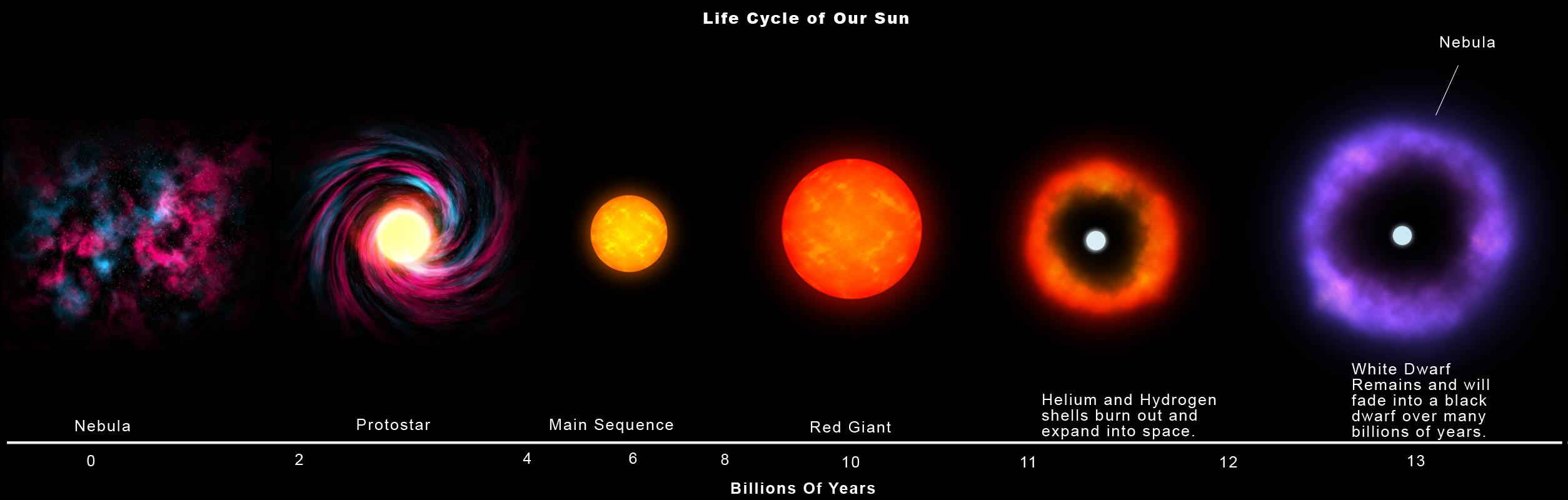
The core will now be hot enough to fuse the existing helium to make carbon. When this helium fuel runs out, another contraction and expansion process will occur, with our dying Sun ejecting its upper layers to form a planetary nebula, an expanding hot shell of gas. The Sun will then cool for many years before becoming a white dwarf, essentially a remnant core. In its last embers, this remnant will continue to cool for several billion years before becoming a black dwarf that emits no heat or light.
For stars more massive than our Sun, its a different story. We don’t just stop at fusing helium into carbon because these stars are massive enough to contract and fuse carbon into heavier elements such as oxygen, neon, silicon, magnesium, sulfur, and iron. Iron is where it ends though. Once the core is mostly iron, the star can “burn” no longer.
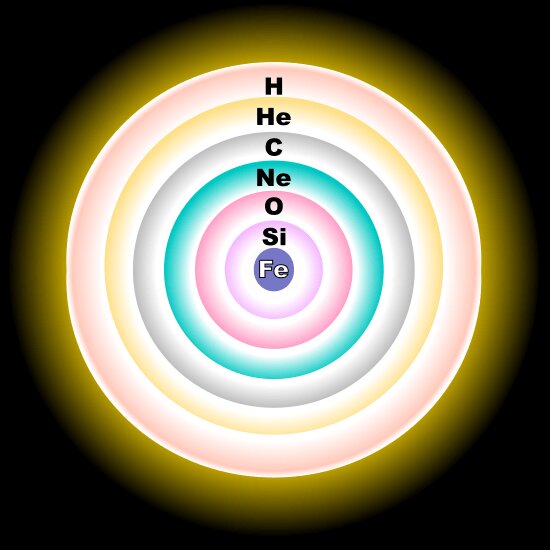
No longer is there any more fuel to hold back the gravity that is causing the star to collapse. At this point, the atoms in the star’s core are mostly stripped of their constituents in what is now a soup of protons and electrons. The core shrinks so tightly that the protons and electrons now merge to form neutrons. The iron core, originally the size of the Earth, now shrinks to form a neutron core with a radius of 10 km.
As the outer layers of the star fall in on the core, it shrinks even further, heating up to billions of degrees, before releasing all this energy in a stellar explosion known as a supernova. The release of all the material that was once formed in the star now exist in the form of interstellar gas clouds which help initiate new stars to form. So yeah, we are all made of star matter!
Whatever remains of the core now forms a neutron star or a black hole depending on the mass of the original star.
All that crushing and shrinking make neutron stars among the smallest and densest objects in the universe. They are the end product of a collapsed supergiant star, that at one point had a mass between 10x to 25x that of our own Sun (1 Sun/solar mass = 333,000 Earths). A single sugar cube of neutron star fluff would weigh one hundred million tons (that is the equivalent of a 100 million baby humpback whales) on Earth. What is stopping a neutron star from collapsing is the pressure exerted by the neutrons in its inner core, now shrunk to such a tiny space, and just jostling around in a fuzzy but ultra-confined gas. It is when we dig deep into the inner core that things get really weird.
Welcome to the world of nuclear pasta! Not much to taste here but they make up for it with their freakiness. Here, matter essentially gets rearranged into exotic shapes. You have that soup of protons, neutrons, and electrons all pushing and pulling at each other resulting in a complete rearrangement of matter. So what do we get?
Well, we start off with the matter slowly clumping together to form gnocchi, then as this clumping increases, we move from spaghetti, waffles, and lasagna. At even higher densities, defects or breaks within the lasagna sheets result in further exotic shapes such as anti-gnocchi, and anti-spaghetti ( or Swiss cheese).
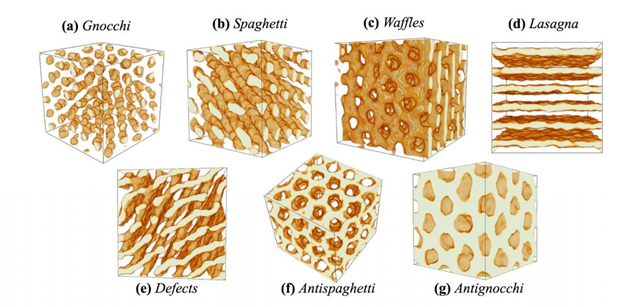
Yes, we believe that the core of a neutron star looks much like Swiss cheese. But there is more!
The deeper we go, there comes a point when all of this stuff turns into a superfluid, a frictionless fluid that forms mini tornadoes or vortices with huge amounts of energy.

Push further to the dead center of the neutron star, we have no proof of what happens here but astrophysicists postulate all kinds of weird and new states of matter that may have last existed in conditions just a fraction of a second before the beginning of our universe.
With that, we end our cooking show for today. Despite being in the throes of “death”, neutron stars have much to tell us about the exotic states of matter that are out there in the universe. It is a lot to digest, I agree, but if you are hungry for more, feel free to check out our video below at PBS Spacetime!


2 thoughts on “Recipe: Nuclear Pasta, Chef: Neutron Star”