
Black holes have captivated our imagination ever since they were first hypothesized by English astronomer and clergyman John Michell, all the way back in 1784.

Michell proposed the idea of a celestial body so massive that even light could not escape it, referring to them as dark stars. Unfortunately, little was made of Michell’s hypothesis. The man was a pioneer and so far ahead of his time that his work was largely forgotten until his writings resurfaced in the 1970s. Fast-forward several years to where we are now, we have confirmed the existence of Michell’s dark stars.
Black holes are now understood as the remnants of stars long dead, and there is variety to their menu. The smallest black holes formed when the universe began. Stellar black holes form when the center of a very big star, about 8 times more massive than our own sun, collapses in upon itself. A million earths can fit in our sun so you can imagine how big these stellar black holes are. Then you have supermassive black holes (not the song by Muse), the big daddies of black holes, found in galactic cores and whose origins remain unknown, with millions to billions of times the mass of the sun.
Since its lights out with black holes, they are invisible to the naked eye. For decades, we have been trying to build bigger and better telescopes to “see” a black hole. For a long time, astronomers could confirm the presence of black holes thanks to their strong gravitational fields that affect the light from the stars and gas surrounding it. An indirect observation, at best.
This all changed when the Event Horizon Telescope captured the first picture of a black hole in 2019. It was a collaborative effort involving hundreds of scientists and teams around the world. Making the image could be equated to piecing together a jigsaw puzzle with data from radio telescopes all around the planet.

Though it seems fuzzy, the resolution of this image is equivalent to one taken if our telescope is the size of Earth. Further refinements of the image have since been made to show details such as the magnetic field surrounding the black hole. This was big news in the field of astronomy because it wasn’t too long ago that black holes were just mathematical probabilities. But, here we are!
It doesn’t just end there. On late July 2021, research scientist Dan Wilkins from the Kavli Institute for Particle Astrophysics and Cosmology at Stanford University, and his team, did one better.

Rather than using a planet-sized telescope Wilkins utilized an already existing technique to understand quasars, extremely bright objects found in the centers of galaxies and powered by gas that is spiraling at high velocities into a supermassive black hole. The technique Wilkins utilized is called Reverberation Mapping. Not only that, Wilkins and his team used reverberation mapping to capture light from behind a black hole! So, what is reverberation mapping and what did Wilkins do?
The gist of the discovery follows what we know about the spectrum of light that we obtain from these quasars. A spectrum is the group of colors that a ray of light can be divided into. The spectrum of visible light consists of various colors from red to violet. A continuous spectrum of visible light means all these colors are observed within their range. An emission or line spectrum shows specific colors corresponding to an atom or molecule transitioning from a high energy state to a low energy state, sort of like musical notes corresponding to specific keys on a keyboard.

The supermassive black hole at the center of a quasar is a beast. A lot of violent phenomena happen at this place and it is not somewhere you wish to be. Wilkins and his team observed one such event when they set their sights on I Zwicky 1 , a mini-quasar, 100 million light years away from us.
Near the event horizon, the point of no return in a black hole, most atoms are broken down and stripped off their constituent electrons- except the most heaviest elements like iron- forming a soup of charged particles or plasma, that surround the black hole in a cloudy haze. This cloud is extremely hot and envelops the black hole, all the while getting heated as it falls in thanks to the gravitational field of the black hole. The magnetic field generated by this accelerated soup of particles arcs high above the black hole before releasing its energy in a giant X-ray flare.
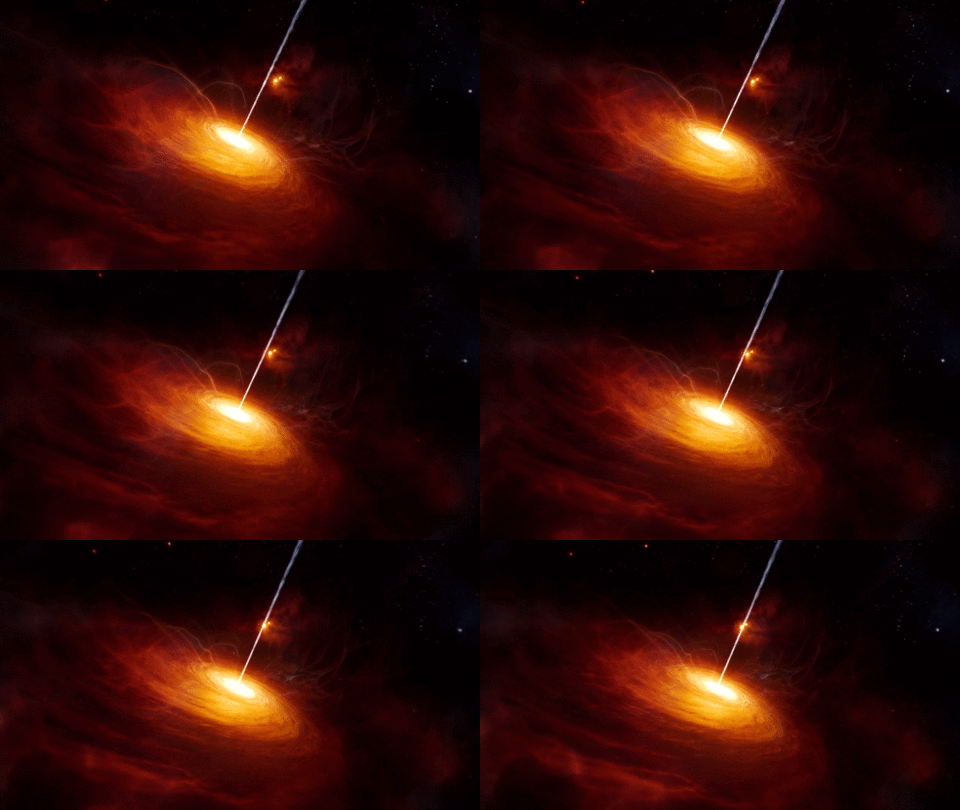
The light from this flare flies out in all directions and can be divided into three main components:
(1) Light traveling out straight to our line of sight.
(2) Light reflecting from the matter, facing our direction, flowing around the black hole.
(3) Light reflecting from the matter, in the opposite direction, behind the black hole where we cannot see.
The black hole takes a portion of this light, thanks to its strong gravitational field, and flings it back around to us in magnifying it in the process. Wilkins and his crew discerned these x-ray echoes or the light from behind the black hole.
The light from the flare reverberates its way through the quasar to reach us many millions of years later. Despite its long journey through space, this light holds an immense amount of information. Reverberation mapping is all about decoding this information by looking at the changes in the spectrum or light from the quasar.
Wilkins and co. did exactly this. The spectrum from a quasar is a combination of a strong continuum intermixed with broad emission lines. Wilkins noted that the emission spectrum of the iron line from I Zwicky 1 had different responses throughout the course of the flare. These differing responses corresponded to the iron line being shifted either to the left (blueshifting, meaning the light is closer to us) or right (redshifting, meaning the light is further from us).
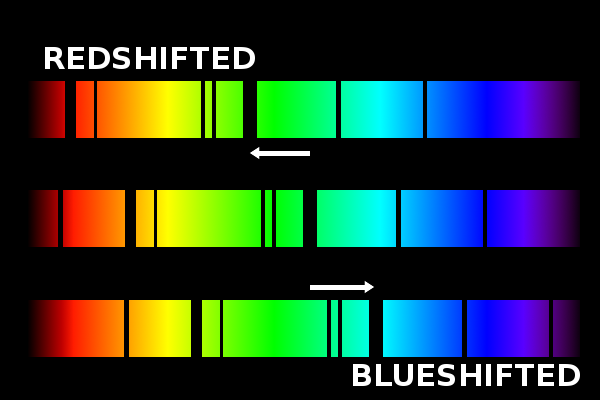
These shifts help us identify where the light is emitted (reflected) from on the disk of matter surrounding the black hole, and the travel time of this light varies according to the distance of each part of the disk from the X-ray flare.
Putting this together, Wilkins and his team deduced that the blueshifted line corresponded to light from the approaching side of the disk and the redshifted line from the receding side, and that the line emission essentially represents “reverberations” or echoes of the X-ray flare from behind the black hole. These light rays are delayed, bent by the gravitational field of the black hole, and are magnified when flung around, resulting in a higher intensity emission spectrum.
Wilkins and co. would go into greater detail with this work extracting even further information from the emission spectra to draw a full 3-D map of the quasar and its physical characteristics, such as its mass. A lot of information from a technique that doesn’t necessitate much on our end, making their work all the more tantalizing.
Incidentally, reverberation mapping was the subject of my second video with PBS Spacetime. Doing the GFX work for this was fun especially because it involved black holes, one of my favorite topics.
The light from these distant cosmic candles have so much to give us, and to think, that just a few hundred years ago, we couldn’t even see them. This discovery is another step forward in our ability now to observe and clearly see black holes. With the wealth of information we have, and with better and better telescopes to come, maybe one day we will able to shed more light on these dark stars.
References
(1) https://www.nature.com/articles/s41586-021-03667-0
(2) https://www.nasa.gov/audience/forstudents/k-4/stories/nasa-knows/what-is-a-black-hole-k4.html
(3) https://en.wikipedia.org/wiki/Reverberation_mapping
(4) https://www.livescience.com/einstein-proven-right-black-hole
(5) https://web.archive.org/web/20110716220923/http://physics.uwyo.edu/~shikatt/reverberationmapping.pdf


One thought on “Hide & Seek – Light From Behind a Black Hole Edition”